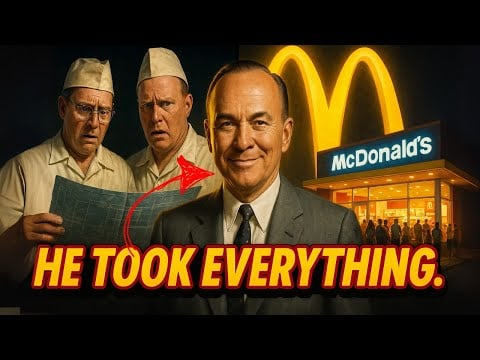
The Most Brilliant Business Theft in American History Was Completely Legal
Ray Kroc's name appears on every McDonald's founder's plaque worldwide, yet he never invented a menu item, designed a restaurant, or created those famous golden arches. The real founders—Mac and Dick McDonald—died watching a stranger profit from their life's work whilst their own names were erased from the empire they built.
This isn't just historical curiosity. Kroc's playbook for systematic corporate acquisition remains the template for how companies are legally stolen from their creators today. Understanding this blueprint isn't just fascinating—it's essential survival knowledge for any founder.
The Brothers' Revolutionary Innovation
In 1948, the McDonald brothers did something that changed American dining forever. After closing their San Bernardino restaurant for three months, they emerged with the "Speedee System"—the world's first assembly line for food service.
The transformation was staggering: a burger that previously took 30 minutes now took 30 seconds. They stripped away complexity, creating a limited menu of hamburgers, cheeseburgers, chips, and drinks. Each worker performed one specific task. The result wasn't just faster service—it was dramatically cheaper. McDonald's burgers cost 15p when competitors charged 35p.
By 1954, this innovation was generating £100,000 annually (equivalent to £1.1 million today) with licensing deals across the country. The brothers had cracked the code on standardisation, speed, and volume. They'd built a goldmine.
Then they met Ray Kroc.
Enter the Corporate Predator
Kroc was a 52-year-old milkshake machine salesman when he discovered a California restaurant ordering eight mixers. Most establishments ordered one or two. Eight suggested something extraordinary.
What happened next reveals the predatory mindset that built modern corporate America. Kroc later admitted that within hours of witnessing the McDonald's operation, he'd identified the brothers as "small-time operators" who didn't grasp the scale of their innovation. Where they saw a successful local business, he envisioned a global empire.
The initial deal appeared equitable: Kroc would handle national franchising, taking 1.9% of gross sales whilst the brothers retained 0.5% and maintained company control. But embedded within this seemingly fair agreement was the first devastating clause—all franchise contracts would run between Kroc and individual operators, not the brothers and operators.
This single provision handed Kroc control over every new McDonald's relationship, effectively isolating the brothers from their own expanding network.
The Real Estate Masterstroke
Kroc's financial advisor, Harry Sonneborn, delivered the insight that transformed McDonald's from a restaurant chain into a corporate juggernaut: they weren't in the food business—they were in real estate.
Instead of merely collecting franchise fees, Kroc began purchasing land and subleasing it to franchisees at profit. This strategy created dual revenue streams whilst delivering ultimate control. Franchisees who resisted Kroc's directives faced eviction, regardless of their success or compliance with the brothers' original standards.
By 1960, Kroc had opened 228 restaurants. The brothers were earning substantial returns, but Kroc was earning more—and growing impatient with their "small-time thinking."
Systematic Destruction of the Original Vision
When the McDonald brothers resisted Kroc's aggressive expansion tactics, he deployed a strategy that reveals the ruthless calculations behind his success. Kroc began opening McDonald's locations directly adjacent to successful independent burger restaurants—sometimes targeting the brothers' own pre-existing licensees.
This wasn't competition; it was systematic destruction of the brothers' alternative business relationships, forcing their complete dependence on his expanding network.
By 1961, after seven years of fighting Kroc's relentless expansion pressure, the brothers accepted his buyout offer of £2.7 million. They thought they were escaping. Instead, they were signing away their legacy.
The Final Betrayal
The buyout contract contained the ultimate insult: the brothers lost rights to their own name. Their original San Bernardino restaurant could no longer operate as McDonald's. Kroc renamed it "The Big M" before eventually forcing its closure entirely.
The McDonald brothers retired to New Hampshire, dying quietly—Dick in 1998, Mac in 1971. Neither witnessed McDonald's evolution into the global empire their innovation had created.
Meanwhile, Kroc became one of America's wealthiest individuals. When he died in 1984, McDonald's served eight billion customers annually across 32 countries.
The Blueprint for Modern Corporate Theft
This story illuminates a harsh truth about contemporary capitalism: innovation and ownership represent entirely different concepts. The brothers innovated; Kroc owned.
Was it theft? Legally, absolutely not. Every contract was signed, every deal was "legitimate." But ethically, Kroc weaponised superior legal knowledge and financial resources to systematically outmanoeuvre two small-town innovators who operated on handshake agreements and basic trust.
This pattern repeats constantly in modern business:
- Technology founders diluted out of their companies through successive funding rounds
- Small businesses crushed by corporate competitors with deeper pockets
- Innovators who create value watching others capture profits
Business schools teach Kroc's story as entrepreneurial masterclass. That should terrify every founder.
The Uncomfortable Questions
The McDonald's acquisition raises fundamental questions about business ethics and capitalist success. The brothers were absolutely correct about quality, innovation, and fair dealing principles. But Kroc was ruthless—and ruthless won.
Does being right matter if you lack ruthlessness? The McDonald brothers created something revolutionary that improved millions of lives and generated enormous value. Yet they ended their careers watching a stranger profit from their life's work whilst their names vanished from the story.
Learning from History's Harsh Lessons
Kroc's takeover wasn't an anomaly—it was a template that continues shaping corporate acquisitions today. The McDonald's story serves as both warning and education for modern founders: legal legitimacy doesn't equal ethical behaviour, and superior resources can overwhelm superior innovation.
Understanding this dynamic isn't about becoming ruthless—it's about recognising when ruthlessness is being deployed against you. The McDonald brothers' tragedy wasn't their commitment to quality or fair dealing. Their tragedy was failing to recognise that their partner operated by entirely different rules.
In the end, McDonald's became the most successful restaurant chain in history. But it was built on the dreams of two brothers who simply wanted to make excellent hamburgers efficiently. Their innovation changed the world. Someone else collected the credit.
Watch the documentary
The McDonald's Heist: How Legal Contracts Can Be Used to Steal Companies
Share
Know someone who'd find this useful? Send it their way.