The Dollar Coin Loophole: How One Man Turned Government Policy into 4 Million Air Miles
Whilst most Americans were ignoring the US Mint's desperate attempts to circulate dollar coins in 2009, Brad Wilson was quietly building what might be the most elegant financial arbitrage in modern history. His method was breathtakingly simple: order coins with a rewards credit card, deposit them at the bank, pay off the balance, and pocket the air miles. The result? Four million miles and a loophole so effective it forced Congress to rewrite federal law.
The Problem Nobody Wanted to Solve
By 2009, the US Mint faced an embarrassing predicament. Millions of freshly minted dollar coins sat gathering dust in government vaults, victims of American consumers' steadfast refusal to embrace them. Unlike previous coin programmes that relied on traditional distribution channels, the Mint took an unprecedented step: they launched an online store offering unlimited quantities of coins, delivered free of charge to anyone's doorstep.
The programme seemed logical on paper—get coins into circulation by making them easily accessible. In practice, it created the perfect conditions for what Wilson would later exploit.
The Arbitrage Window Opens
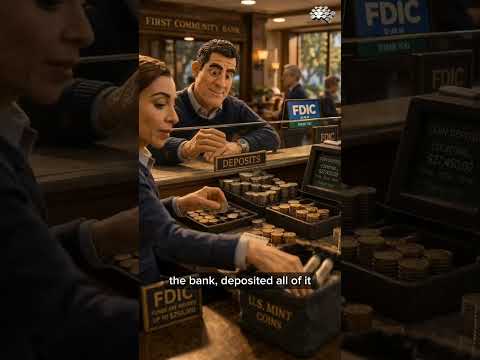
"He pulled out his frequent flyer credit card, ordered thousands of dollars worth of coins, waited for the armoured truck to pull up to his house, loaded every single coin into his car, drove straight to the bank."
Wilson's breakthrough came from reading what others merely skimmed. Whilst most people saw a mildly interesting government programme, he recognised a risk-free arbitrage opportunity hiding in plain sight. The mechanics were elegant in their simplicity:
- Order maximum quantities of dollar coins using a rewards credit card
- Receive free delivery via armoured truck
- Transport coins directly to the bank for deposit
- Use deposited funds to pay credit card balance
- Retain all accumulated rewards points
The beauty lay in the complete absence of financial risk. Wilson never carried a balance, never paid interest, and never invested his own capital. He was essentially using the US government as his personal rewards programme administrator.
Scaling the System
4 million air miles—that's the staggering total Wilson accumulated through systematic exploitation of the programme. This wasn't a one-off opportunistic grab; it was methodical, repeated execution of a perfectly legal strategy.
The logistics alone were remarkable. Armoured trucks regularly pulled up to Wilson's residence, delivering thousands of dollars in coins that he would personally transport to banking facilities. Each transaction generated legitimate credit card rewards whilst costing him nothing out of pocket.
What makes Wilson's approach particularly noteworthy is the discipline required. Lesser individuals might have attempted to complicate the strategy or become greedy in ways that could have attracted unwanted attention. Wilson kept it simple, systematic, and entirely within the bounds of both the programme's terms and federal law.
The Government Response
When officials finally understood what was happening, their response was swift and comprehensive. They didn't merely close the online store or modify the programme terms—they changed federal law specifically to prevent similar exploits.
"If you know anything about how slowly governments move, that alone tells you how badly Brad had won."
This legislative response speaks volumes about the scale and effectiveness of Wilson's strategy. Governments typically react to widespread problems affecting thousands or millions of people, not individual exploits. The fact that Congress felt compelled to address Wilson's specific method suggests his impact was far more significant than the raw numbers might indicate.
The regulatory changes effectively ended similar opportunities for future operators, cementing Wilson's position as perhaps the only person to successfully execute this particular arbitrage at scale.
The Ethics of Exploitation
Wilson's story raises fascinating questions about the ethics of exploiting poorly designed systems. He broke no laws, violated no terms of service, and caused no direct harm to individuals. His actions were entirely predictable consequences of the programme's structure—consequences that any competent policy analysis should have anticipated.
The mint created a system that incentivised exactly the behaviour Wilson exhibited. In many ways, he was simply the most efficient participant in a programme that was fundamentally flawed from inception.
Lessons in Opportunity Recognition
Wilson's success illuminates crucial principles about opportunity recognition in complex systems:
Reading Between the Lines
Whilst others saw a mundane government programme, Wilson identified the underlying economic mechanics that made arbitrage possible. This required looking beyond surface-level information to understand how different systems might interact.
Speed of Execution
Recognising an opportunity means nothing without rapid execution. Wilson acted whilst the window remained open, understanding that such advantageous conditions rarely persist indefinitely.
Risk Management
The strategy's elegance lay partly in its risk profile. Wilson structured his approach to eliminate downside exposure whilst maintaining unlimited upside potential.
The Broader Context
Wilson's exploit represents a fascinating intersection of government policy, financial engineering, and individual initiative. It demonstrates how well-intentioned programmes can create unintended consequences when their designers fail to consider all possible interactions with existing systems.
The story also highlights the importance of comprehensive policy analysis. The Mint's programme solved one problem—coin distribution—whilst inadvertently creating another: subsidising rewards programme arbitrage for savvy individuals.
A Perfect Storm of Circumstances
Looking back, Wilson's success required a unique confluence of factors: an unlimited government programme, free shipping, credit card rewards systems, and accessible banking infrastructure. Remove any single element, and the arbitrage becomes impossible.
This perfect storm nature explains why similar opportunities are exceedingly rare. It also suggests that Wilson's timing and execution were genuinely exceptional rather than simply lucky.
Wilson never cheated, never stole, never broke a single rule. He simply read what everyone else skimmed past and acted whilst the window remained open. In a world where complex systems create countless hidden opportunities, his story serves as a masterclass in recognising and exploiting them—entirely within the bounds of law and ethics.
Watch the documentary
The Dollar Coin Loophole: How One Man Turned Government Policy into 4 Million Air Miles
Share
Know someone who'd find this useful? Send it their way.