The Russian Who Beat theBanks at Their Own Game
Dimitri Agarkov turned the tables on Russia's banking system by rewriting a credit card contract and getting the bank to unknowingly sign it. His audacious legal gambit resulted in a $700,000 victory against one of Russia's most powerful financial institutions.
Opening
Dimitri Agarkov received a credit card offer in the post like millions of Russians do every year. The usual predatory nonsense: sky-high interest rates buried in microscopic text, fees for breathing, penalties for existing.
Most people bin these offers. Some sign them without reading. Agarkov did something else entirely.
He rewrote the whole bloody thing.
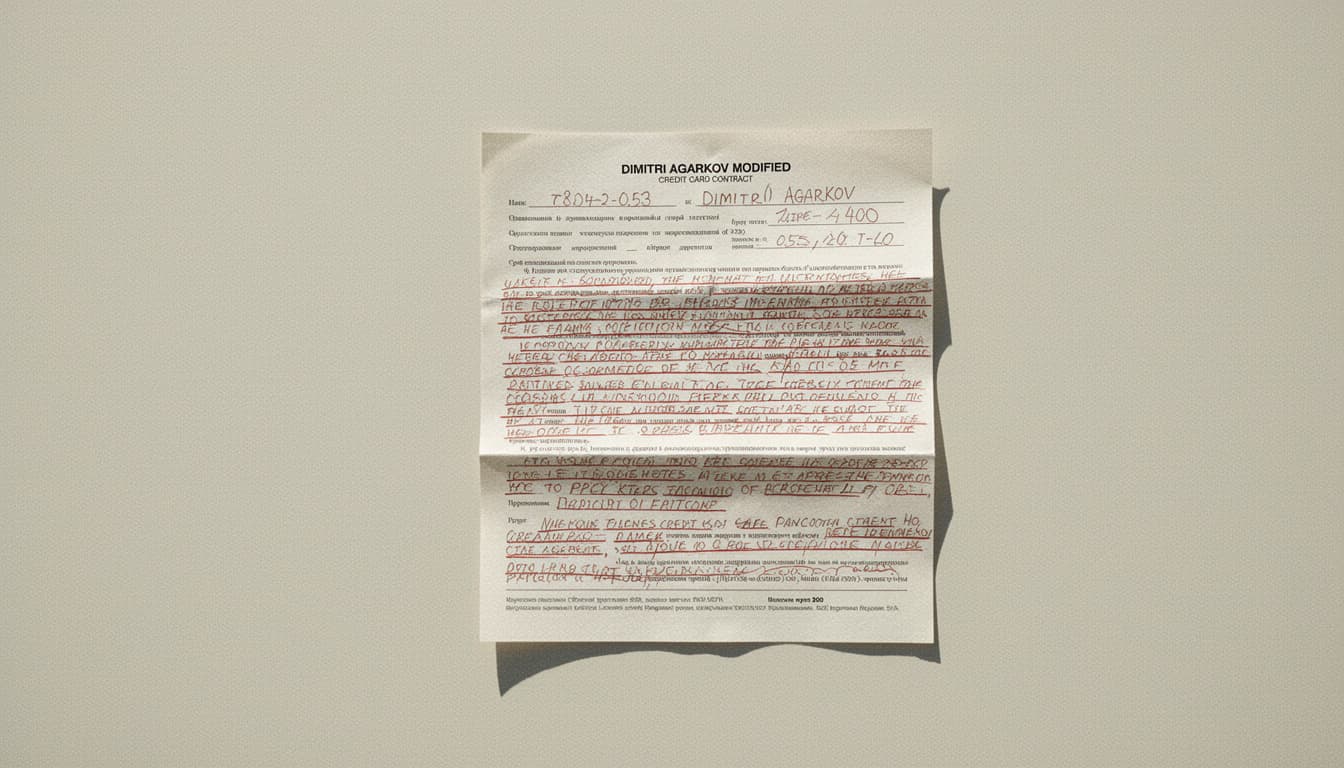
Where the bank demanded crushing interest rates, he pencilled in zero per cent. Where they'd stuffed the contract with fees, he struck them out. Then came his masterstroke: a clause buried deep in the revised document stating that if the bank violated any terms, they'd owe him $90,000.
Every contract you sign without reading is a blank cheque you hand to someone else.
He posted it back to them.
The Bank Takes the Bait
The bank's processing department, running on corporate autopilot, stamped the contract without reading it. Classic institutional behaviour: assume the customer has signed whatever dreck you sent them.
For two years, Agarkov used his credit card freely. Paid nothing. Waited.
When the bank finally woke up and sued him for unpaid fees, they walked straight into his trap. In court, as their lawyers presented their case, Agarkov calmly produced their signature on his modified contract.
By applying the same attention to a contract that banks expect from their customers, he used their own system against them.
Counter-suit: $700,000.
The judge sided with Agarkov. He'd broken no laws, hacked no systems. He'd simply done what banks never expect customers to do: read what he was signing and understand it.
Every contract you sign without reading is a blank cheque you hand to someone else.
The System Exposed
Agarkov's victory reveals how the entire financial services industry operates. Banks present customers with contracts designed to extract maximum profit, banking on the reality that most people won't read the microscopic text.
It's information asymmetry at its most brazen. They know what's in the contracts. You don't. They profit from that gap.
Sometimes the most powerful weapon against bureaucracy is simply reading what it asks you to sign.
Agarkov flipped the dynamic. Every contract you sign without reading is a blank cheque you hand to someone else. He refused to hand his over.
By applying the same attention to a contract that banks expect from their customers, he used their own system against them.
Power Play
This wasn't just one bloke outsmarting a bank. It's about who holds real power in financial relationships.
For decades, banks have assumed their size, resources, and legal departments give them insurmountable advantages over individual customers. Their business model depends on customer passivity.
Agarkov proved that assumption catastrophically wrong. By applying the same attention to a contract that banks expect from their customers, he used their own system against them.
The beauty lies in its simplicity. No inside knowledge required. No expensive lawyers. No connections in high places. Just two things most people possess but rarely use: willingness to read what they're signing and confidence to negotiate.
Banks count on customers doing neither. They'd rather you stay ignorant and compliant.
Sometimes the most powerful weapon against bureaucracy is simply reading what it asks you to sign.
The Real Question
Could Agarkov's approach be replicated? Absolutely. The real question is whether most people would have the nerve to try.
In a system designed to make individuals feel powerless against institutional might, Agarkov's $700,000 victory proves that sometimes the most powerful weapon against bureaucracy is simply reading what it asks you to sign.
The banks won't be making that mistake again. But they're still betting you won't read the fine print.
Watch the documentary
The Russian Who Beat the Banks at Their Own Game
End of file
The next one drops Sunday at 7am.
One long-form story a week, plus the tools, frameworks and tactics I’m using to run my own media business. Written from the operator’s seat — not the consultant’s.
No threads. No spam. Reply anytime — I read every one.