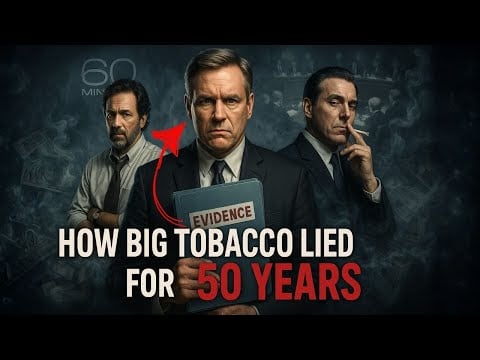
The $246 Billion Lie: How One Whistleblower Brought Down Big Tobacco's Five-Decade Deception
In corporate boardrooms across America, tobacco executives sat examining scientific reports that proved their products killed people. They knew cigarettes were addictive. They knew they caused cancer. Yet for over five decades, they chose profit over truth, constructing one of the most sophisticated deception campaigns in business history.
This isn't merely a story about corporate malfeasance—it's a masterclass in how industries can weaponise doubt, manipulate science, and systematically lie to entire nations whilst generating billions in revenue. Until one man decided he'd had enough.
The Theatre of Denial
The most brazen moment came in 1994, when seven tobacco executives stood before Congress and swore under oath that nicotine was not addictive. Each man, representing companies worth billions, delivered the same rehearsed line with practised conviction.
Behind their boardroom doors, however, a very different conversation was taking place. Internal documents would later reveal that tobacco companies had long understood nicotine's true nature: a drug more addictive than cocaine and harder to quit than heroin. When inhaled, nicotine reaches the brain in just ten seconds, hijacking the reward system and creating immediate physical dependence.
"Nicotine is more addictive than cocaine, and harder to quit than heroin."
Far from simply hiding this inconvenient truth, tobacco companies were perfecting it through a process they euphemistically called 'impact boosting.' Using ammonia chemistry, filter modifications, and strategic additives, they engineered cigarettes to deliver nicotine to the brain faster and more efficiently. These weren't tobacco products—they were pharmaceutical delivery systems designed to create and maintain addiction.
Engineering the Next Generation of Customers
The industry's second devastating lie concerned their target market. Publicly, tobacco companies denied marketing to children. Privately, they understood a harsh demographic reality: they needed to replace the 400,000 Americans who died from smoking each year.
Cartoon mascots like Joe Camel weren't coincidental marketing choices—they were calculated strategies to capture young minds. Internal documents revealed the industry's guiding principle: 'The younger the smoker, the longer the customer.' With 90% of smokers beginning before age 18, children weren't collateral damage in tobacco's business model—they were the business model itself.
Manufacturing Scientific Doubt
Perhaps the most insidious element of tobacco's strategy was their systematic corruption of scientific discourse. For decades, they funded fake research designed not to discover truth, but to manufacture uncertainty.
They established official-sounding organisations like the 'Tobacco Institute' and the 'Council for Tobacco Research'—elaborate propaganda machines masquerading as legitimate scientific bodies. Their mission wasn't to conduct research, but to create the illusion of scientific debate where none existed.
The strategy was devastatingly simple: as long as the public remained confused about smoking's health effects, people continued buying cigarettes. They weaponised the very foundations of scientific inquiry, turning peer review and academic discourse into tools of deception.
The Insider's Moral Reckoning
Jeffrey Wigand was a research scientist at Brown & Williamson, one of America's major tobacco companies. But unlike his colleagues who compartmentalised their work, Wigand couldn't ignore what he was seeing. Internal memos referred to smokers as 'biological nicotine delivery systems'—not customers, not people, but test subjects in a vast addiction experiment.
"Customers weren't people; they were test subjects."
Wigand possessed something that terrified the industry: documentation. He had internal papers showing how Brown & Williamson systematically manipulated nicotine levels across different brands. He understood that his employer wasn't operating as a traditional tobacco company—it was functioning as an unregulated pharmaceutical manufacturer, engineering addiction without calling it medicine.
When Brown & Williamson terminated Wigand for pushing safety concerns, they believed they'd solved their problem. Instead, they'd created their worst nightmare: a former insider with comprehensive knowledge, damning evidence, and nothing left to lose.
Corporate Warfare
The moment Wigand agreed to speak publicly, Brown & Williamson deployed what can only be described as corporate warfare. They hired private investigators to excavate his personal history. They spread rumours questioning his mental stability. They threatened his family's safety through legal intimidation and character assassination designed to destroy his credibility before he could testify.
The campaign's sophistication was breathtaking. This wasn't merely aggressive litigation—it was systematic personal destruction orchestrated by one of America's most powerful industries.
Even CBS's '60 Minutes,' renowned for confronting corporate power, initially buckled under pressure. When the tobacco industry threatened lawsuits that could bankrupt the network, CBS executives killed Wigand's explosive interview, choosing corporate survival over journalistic integrity.
The Dam Breaks
Truth, however, has a way of finding daylight. Wigand's testimony in a Mississippi lawsuit, protected by legal privilege, finally provided the breakthrough. His deposition revealed everything: internal documents proving tobacco companies knew their products killed consumers, evidence of systematic nicotine manipulation, and proof of a decades-long conspiracy to deceive the American public.
The evidence was overwhelming and undeniable. State after state launched lawsuits against Big Tobacco. The industry that had successfully deflected accountability for fifty years suddenly found itself facing coordinated legal assault across multiple fronts.
The Reckoning
In 1998, the tobacco industry agreed to pay $246 billion in settlements—the largest corporate legal settlement in American history. The sum represented not just financial penalty, but formal acknowledgement of their systematic deception.
Yet even today, the human cost continues mounting. Nearly 480,000 Americans die annually from tobacco use, whilst globally, 8 million lives are lost each year. Despite FDA regulation and widespread awareness, nicotine remains at the heart of tobacco products, and the addiction mechanisms Wigand exposed continue operating largely unchanged.
The tobacco industry's five-decade deception campaign represents more than corporate malfeasance—it's a case study in how powerful interests can systematically subvert truth, manipulate democratic institutions, and prioritise profit over human life. Wigand's courage didn't just expose one industry's lies; it demonstrated that even the most sophisticated deception campaigns ultimately cannot withstand determined truth-telling.
The $246 billion settlement was significant, but the real victory was simpler: after fifty years of lies, America finally heard the truth.
Watch the documentary
The $246 Billion Lie: How One Whistleblower Brought Down Big Tobacco's Five-Decade Deception
Share
Know someone who'd find this useful? Send it their way.