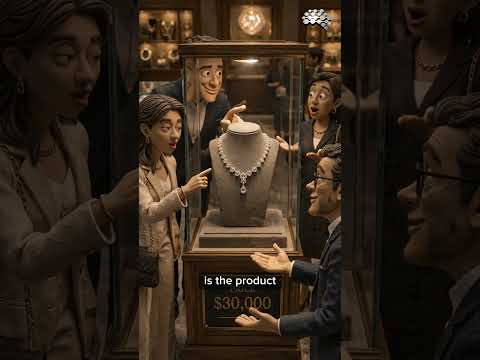
When Economics Gets Turned on Its Head
In 1899, economist Thorstein Veblen stumbled upon an observation that shattered conventional wisdom about consumer behaviour. He watched, bewildered, as luxury goods defied the basic law of supply and demand: when prices rose, sales increased rather than declined. This wasn't a market anomaly—it was a deliberate feature of human psychology that would go on to explain billions in consumer spending over the following century.
Veblen's discovery, detailed in The Theory of the Leisure Class, introduced the concept of conspicuous consumption. Today, we recognise this phenomenon as the Veblen Effect: the counterintuitive principle that certain products become more desirable precisely because they cost more.
The Price Is the Product
A Veblen good operates on a simple but profound premise: the price itself becomes the primary selling point. These products aren't purchased for superior functionality or craftsmanship—they're bought because their cost signals status, exclusivity, and social positioning.
Consider the remarkable transformation of Pappy Van Winkle bourbon. In 1990, a bottle sold for a modest £3, and consumers largely ignored it. The distillery made a calculated decision: they repeatedly raised prices over two decades without altering the recipe or production methods. By 2013, the same bourbon was commanding £1,500 on secondary markets, with waiting lists stretching years.
The bourbon remained identical. The perception transformed entirely.
This wasn't accidental pricing—it was strategic psychology. The higher price didn't reflect improved quality; it created a new category of desire. Suddenly, Pappy Van Winkle wasn't just whiskey—it was a symbol of discernment, success, and insider knowledge.
The Hermès Playbook
Hermès has perfected this strategy with the legendary Birkin bag. The French luxury house deliberately restricts supply whilst maintaining stratospheric prices, creating what amounts to a luxury goods paradox: the harder something is to obtain, the more desperately people want it.
The Birkin bag's functionality as a handbag is almost irrelevant to its appeal. Customers aren't purchasing storage solutions—they're buying proof of their status, their patience, and their ability to navigate exclusive social circles. The waiting list itself becomes part of the product's allure, transforming potential frustration into coveted membership.
The Exclusivity Engine
The most sophisticated brands understand that scarcity and high prices don't shrink markets—they create entirely new ones. Traditional economics suggests that raising prices reduces demand, but Veblen goods operate in a different universe where conventional rules don't apply.
This strategy works because it taps into fundamental human psychology. When something is expensive and difficult to obtain, our brains interpret these signals as indicators of value and desirability. The price becomes shorthand for quality, exclusivity, and social status—even when the underlying product remains unchanged.
Beyond Luxury Goods
The Veblen Effect extends far beyond handbags and bourbon. High-end restaurants, exclusive memberships, premium education, and even certain technology products leverage this principle. Apple's premium pricing strategy, for instance, doesn't just reflect production costs—it reinforces the brand's positioning as a status symbol.
Consultancies and professional services also employ Veblen pricing. The most expensive lawyers, consultants, and advisors often attract more clients than their moderately-priced competitors, not because they deliver proportionally better results, but because their fees signal expertise and exclusivity.
The Message Within the Price
Veblen's insight reveals a crucial truth about modern commerce: price is never just a number. It's a sophisticated communication tool that conveys messages about quality, exclusivity, and social positioning. In markets where status matters, raising prices doesn't deter customers—it creates them.
This principle challenges fundamental assumptions about value and competition. The most powerful brands don't compete primarily on functional benefits or cost-effectiveness. Instead, they compete on exclusivity, prestige, and the psychological rewards of ownership.
The Paradox of Desire
The Veblen Effect illuminates something profound about human nature: we often want things more intensely when they're harder to have. This isn't limited to conscious status-seeking—it operates at a deeper psychological level, where difficulty of acquisition translates directly into perceived value.
Smart brands recognise this paradox and design their entire business models around it. They understand that in certain markets, accessibility is the enemy of desirability. Making something easier to buy doesn't always increase sales—sometimes it destroys the very appeal that drove demand in the first place.
Veblen's century-old observation continues to shape modern commerce, revealing that the most expensive path isn't always the least profitable. Sometimes, it's the only way to build a truly premium brand. The lesson remains as relevant today as it was in 1899: in the right market, raising prices doesn't shrink your audience—it creates one.
Watch the documentary
The Veblen Effect: How Raising Prices Creates Demand
Share
Know someone who'd find this useful? Send it their way.