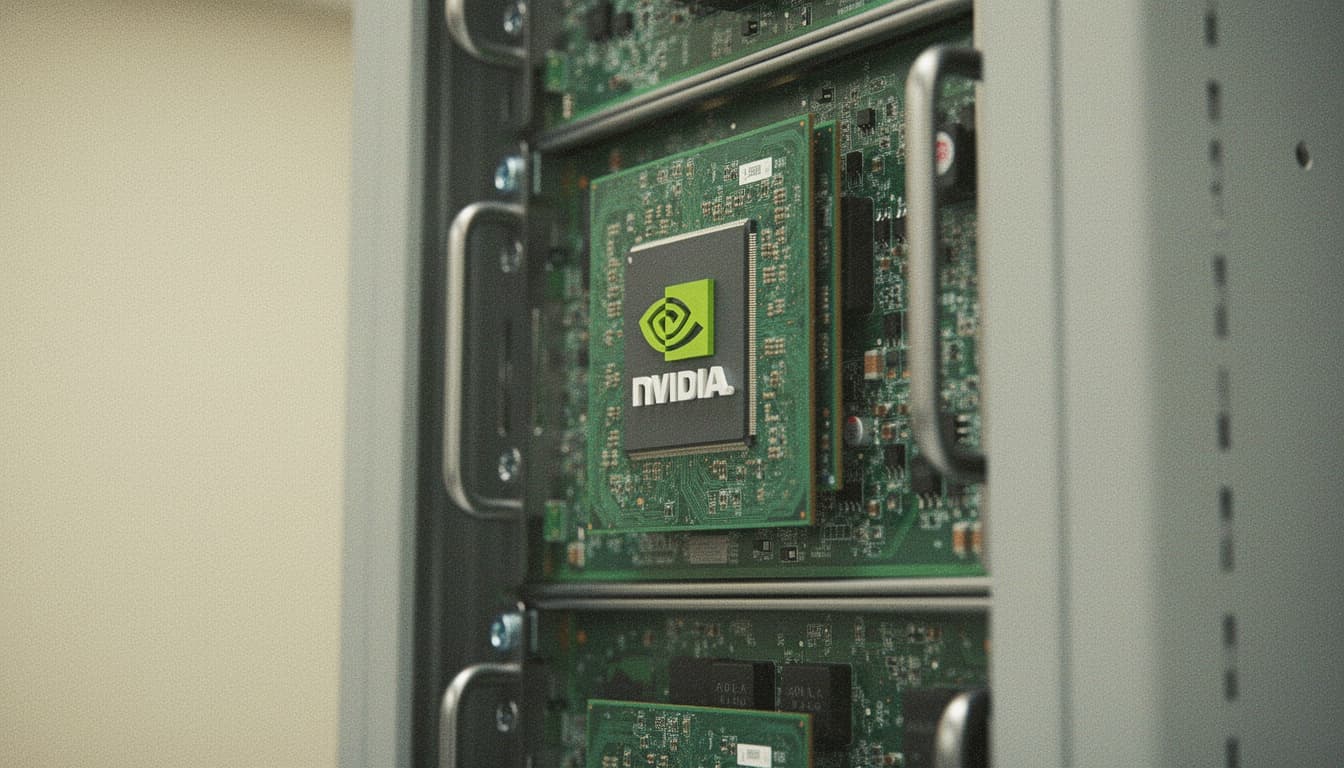
The Real Story BehindNVIDIA's Market Dominance
Jensen Huang bet his company on a future nobody else could see. Thirty years later, NVIDIA is worth $3 trillion. This is how it actually happened.
Opening
Three engineers sat in a Denny's restaurant in San Jose thirty-three years ago and decided to make chips for video games. Today, that company is worth more than the GDP of most European nations.
The restaurant is still there. The company, NVIDIA, just crossed $3 trillion in market capitalisation.
Jensen Huang, Chris Malachowsky, and Curtis Priem founded NVIDIA with a thesis the semiconductor establishment considered laughable: that 3D graphics processing would justify dedicated silicon. Intel ruled. The CPU was king. The idea that a specialised graphics chip could anchor a trillion-dollar empire would have been dismissed in any Silicon Valley boardroom.
Yet here we are. NVIDIA is the most valuable semiconductor company on Earth and arguably the most crucial tech firm of the AI era. But the path from pancakes to dominance wasn't linear. It was three decades of calculated bets, near-death moments, and strategic pivots that created a technology monopoly hiding in plain sight.
They took a marginal idea about gaming chips and positioned their company at the exact centre of the century's most consequential technology shift.
The GPU Was Never Just About Games
NVIDIA's first product, the NV1, shipped in 1995 and bombed spectacularly. It used quadratic texture mapping instead of the polygon-based approach everyone else had adopted. The tech was arguably superior, but it couldn't work with Microsoft's emerging DirectX standard. Game developers couldn't build for it.
The chip flopped. The company nearly died.
Huang later called this NVIDIA's closest brush with bankruptcy. But failure taught him something that would define the company for thirty years: in platform markets, ecosystem compatibility trumps raw technical brilliance. You don't win with the best chip. You win with the chip developers actually use.
NVIDIA pivoted to polygon rendering, shipped the RIVA 128 in 1997, and immediately stole market share from 3Dfx, the graphics king at the time. The product was good enough, cheap enough, and crucially, compatible with DirectX. Within two years, NVIDIA was the fastest-growing semiconductor company in the world.
You don't win with the best chip. You win with the chip developers actually use.
CUDA: The Decision That Changed Everything
In 2006, NVIDIA released CUDA (Compute Unified Device Architecture). It was a programming platform that let developers use NVIDIA GPUs for general computing, not just graphics rendering. Inside the company, the decision was controversial. GPUs were for games. Why invest hundreds of millions in software that turned gaming chips into scientific calculators?
Huang understood something with almost prophetic clarity: massively parallel processing would eventually dominate computing for an entire category of workloads that barely existed yet. Machine learning. Molecular simulation. Climate modelling. Financial risk analysis. Any problem that could split into thousands of simultaneous calculations was a problem GPUs could solve orders of magnitude faster than CPUs.
But CUDA wasn't just technical infrastructure. It was ecosystem strategy. By giving researchers and developers free, accessible tools to programme NVIDIA's GPUs, Huang built a moat competitors would need a decade just to begin replicating. Every PhD student learning CUDA, every research paper using NVIDIA hardware, every startup building models on CUDA-accelerated frameworks became part of an installed base that made switching competitors economically irrational.
Here's the thing most people miss about NVIDIA's $3 trillion valuation: it's not primarily a hardware story. It's a software ecosystem story. AMD makes competitive chips. Intel is trying. Google has its own TPUs. None of them have CUDA's developer ecosystem. Rebuilding that from scratch would take years, billions, and offer no guarantee of success.
NVIDIA's $3 trillion valuation isn't primarily a hardware story. It's a software ecosystem story.
They took a marginal idea about gaming chips and positioned their company at the exact centre of the century's most consequential technology shift.
The Deep Learning Inflection
In 2012, a University of Toronto team used NVIDIA GPUs to train a neural network called AlexNet that crushed the ImageNet image recognition benchmark. The model's error rate was nearly half the next best approach. Computer science was stunned. Deep learning went from academic curiosity to existential priority for every major tech company overnight.
NVIDIA was ready. Not by luck, but because Huang had positioned the company for exactly this moment for six years. The CUDA ecosystem was mature. The hardware was purpose-built for the matrix multiplication neural networks require. NVIDIA had courted the academic machine learning community, sponsoring research, donating hardware to universities, building relationships with people who would architect the AI revolution.
When Google, Facebook, Microsoft, and Amazon poured billions into AI infrastructure between 2015 and 2020, they all bought NVIDIA GPUs. Not because alternatives didn't exist, but because alternatives meant rewriting codebases, retraining engineers, and accepting performance trade-offs the AI arms race timeline made impractical. NVIDIA's ecosystem lock-in turned hardware advantage into structural monopoly.
The Data Centre Pivot
For most of its history, NVIDIA's revenue came from gaming. Gamers bought GPUs for increasingly photorealistic games. The company's roadmap followed that market's demands. Then around 2018, something shifted. Data centre revenue driven by cloud providers buying NVIDIA hardware for AI training began growing faster than gaming. By 2024, data centres accounted for over 80% of total revenue.
This wasn't gradual transition. It was phase change. The A100 chip launch in 2020, followed by the H100 in 2022, created products so purpose-built for AI workloads they became the standard for training large language models. OpenAI trained GPT-4 on clusters of NVIDIA H100s. So did Google, Anthropic, Meta, and virtually every company building frontier AI models.
Margins on these data centre chips were extraordinary: gross margins above 70%, sometimes approaching 80%. NVIDIA sold picks and shovels in the AI gold rush, except the tools were so specialised and embedded in customer workflows that switching was nearly impossible. Quarterly earnings reports read like dispatches from another economic reality: revenue doubling year over year, profits exceeding most semiconductor companies' total revenue.
You don't win with the best chip. You win with the chip developers actually use.
Jensen Huang's Management Philosophy
Huang's leadership style is unusual in Silicon Valley. He has no traditional direct reports, or rather, he has dozens. The company operates with a flat structure where approximately 55 people report directly to the CEO. No scheduled one-on-ones. Communication flows through "top five priorities" emails, where executives share critical issues and Huang responds to all of them.
This structure would create chaos at most companies. At NVIDIA, it creates information density at the top that gives Huang visibility into operational details most CEOs lose once their company exceeds a few hundred people. He famously knows specific chip design status, individual research project progress, and competitive dynamics of markets NVIDIA hasn't entered yet.
He's also extraordinarily demanding. Former employees describe a culture where mediocrity isn't tolerated and everyone operates at their capability limit constantly. This creates attrition but also self-selects for people who thrive under pressure and align deeply with the company's mission.
The leather jacket is costume. The intensity behind it isn't.
The Competitive Landscape
NVIDIA's dominance faces challenges. AMD, under Lisa Su, has made gains with its MI300 series AI accelerators. Google's TPUs power much internal AI infrastructure and serve external customers through Google Cloud. Amazon developed Trainium chips for training and Inferentia for inference. Intel attempts a comeback with Gaudi accelerators.
Then there are custom silicon efforts. Microsoft, Meta, and Apple all develop their own AI chips, motivated by desire to reduce dependence on a single supplier whose pricing power feels uncomfortably strong.
But competitive threats are less immediate than they appear. Custom chips take years to develop, validate, and deploy at scale. The software ecosystem around NVIDIA, not just CUDA, but layers of frameworks, libraries, and tools built on top, represents an installed base that cannot be replicated by hardware alone. A competitor doesn't just need a better chip; they need a better chip AND must convince millions of developers to rewrite code for it. That's a much harder problem.
NVIDIA's $3 trillion valuation isn't primarily a hardware story. It's a software ecosystem story.
The $3 Trillion Question
NVIDIA's current valuation implies markets believe AI infrastructure spending will grow at extraordinary rates indefinitely, and that NVIDIA will maintain dominant share. Both assumptions are reasonable medium-term. Neither is guaranteed forever.
The bull case is straightforward: AI represents the most significant computing paradigm shift since the internet, infrastructure buildout remains early-stage, and NVIDIA's ecosystem moat is so deep that even well-funded competitors need five to ten years to meaningfully erode market share. Here, NVIDIA's revenue continues compounding, margins remain exceptional, and the company becomes the world's most valuable. Full stop.
The bear case is more nuanced. AI spending could decelerate if enterprise adoption of large language models proves slower or less profitable than expected. Cloud providers could accelerate custom chip programmes, reducing NVIDIA reliance. The very success of NVIDIA's monopoly position could attract regulatory scrutiny as governments view AI infrastructure as strategically important.
What's not in question is what Jensen Huang and his co-founders accomplished. They took a marginal idea about gaming chips, built an ecosystem around it with patience and precision, and positioned their company at the exact centre of the century's most consequential technology shift.
That Denny's in San Jose should put up a plaque.
Watch the documentary
The Real Story Behind NVIDIA's Market Dominance
End of file
The next one drops Sunday at 7am.
One long-form story a week, plus the tools, frameworks and tactics I’m using to run my own media business. Written from the operator’s seat — not the consultant’s.
No threads. No spam. Reply anytime — I read every one.