How MrBeast Built a Billion-DollarEmpire From His Bedroom
Jimmy Donaldson didn't just crack the YouTube algorithm — he reverse-engineered attention itself. Inside the playbook that turned a teenager into a media mogul.
Opening
There's a house in Greenville, North Carolina, that looks like every other house on the street. Vinyl siding, modest lawn, the kind of place you'd drive past without a second glance. Between 2012 and 2017, a teenager sat in one of its bedrooms uploading videos to YouTube with the manic persistence of someone who had already decided the outcome.
Most of those videos got fewer views than a school assembly. He uploaded them anyway.
That teenager was Jimmy Donaldson. Today he operates under the name MrBeast, commands an audience of over 300 million subscribers across platforms, and has built a business empire valued north of $1.5 billion. He is, by any reasonable measure, the most successful individual creator in the history of digital media.
But the story of how he got there isn't a fairy tale about going viral. It's a case study in obsession, reinvestment, and the ruthless science of attention.
He studied YouTube the way a doctoral student studies particle physics. Not casually, not as a hobby, but as a total intellectual commitment.
The Ten Thousand Hours Nobody Saw
Before the philanthropy stunts and the chocolate bars and the burger chains, there were years of nothing. Donaldson started uploading at thirteen. He studied YouTube the way a doctoral student studies particle physics. Not casually, not as a hobby, but as a total intellectual commitment.
He spent thousands of hours analysing thumbnails, retention graphs, click-through rates, and the behavioural patterns of viewers who stayed versus those who bounced in the first three seconds. This wasn't the behaviour of a teenager making content for fun. This was systematic research.
Donaldson and a small circle of fellow creators would get on Skype calls lasting six, eight, sometimes twelve hours, dissecting why certain videos performed and others didn't. They built mental models of the algorithm before most creators even understood there was an algorithm to game.
The breakthrough insight was deceptively simple: YouTube's recommendation engine rewards watch time above all else. Not views, not likes, not subscribers. Sustained, uninterrupted attention.
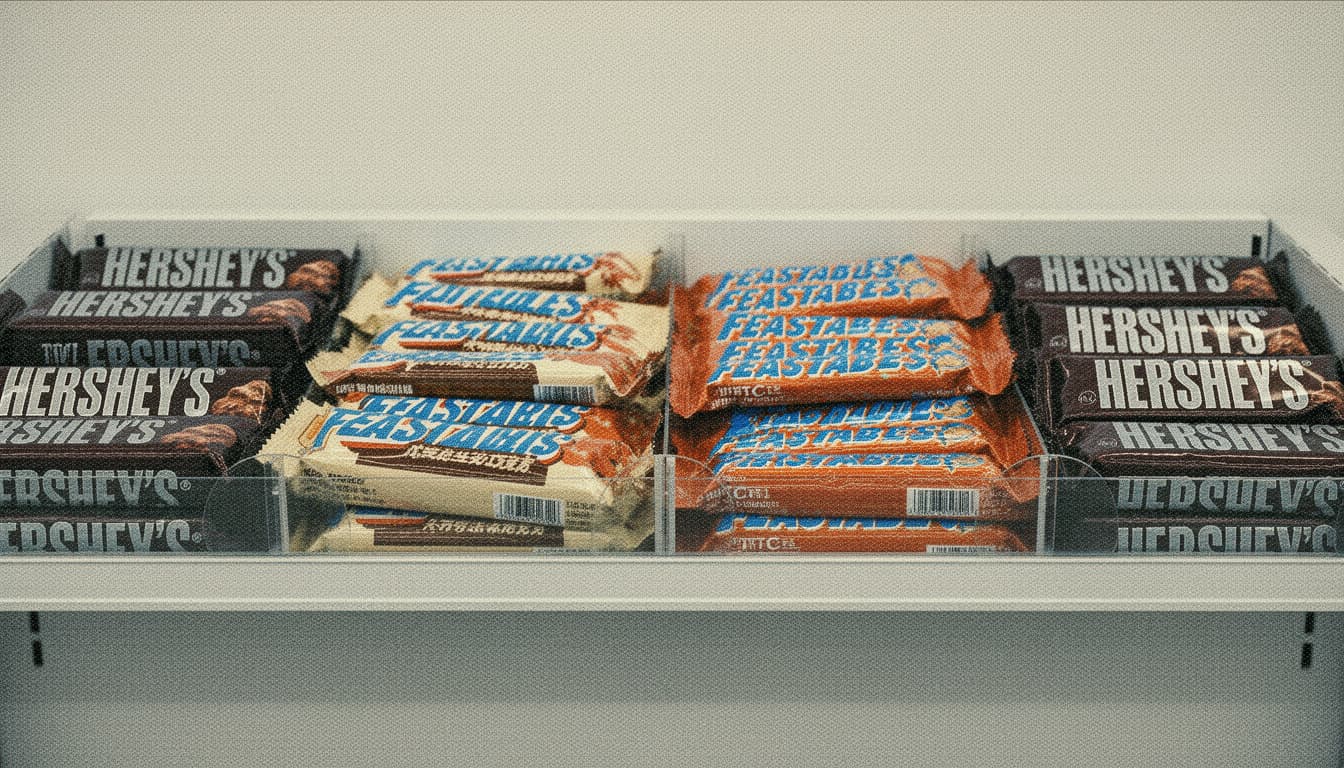
The chocolate bars weren't competing with other creator brands. They were competing with Hershey's and Mars.
Every creative decision Donaldson has made since can be traced back to this single principle. The escalating stakes of his challenges, the ticking clocks, the emotional payoffs. All of it is engineered to keep you watching until the end. And it works. His average view duration consistently outperforms channels with ten times his production budget.
Here's what separates MrBeast from every other creator who understood the algorithm: he refused to take money off the table. For years, every dollar of ad revenue went back into the next video. When a video earned $10,000, the next one had a $10,000 budget. When it earned $100,000, that became the new floor.
This compounding reinvestment strategy meant his production quality was always escalating, always one step ahead of audience expectations.
Most creators hit a ceiling because they start optimising for personal income. They buy the house, lease the car, hire the assistant, and plateau. Donaldson did the opposite. He lived modestly, paid his small team, and poured everything else into content that was increasingly impossible to ignore.
This isn't influence in the way the word is typically used. This is infrastructure. Donaldson built an attention pipeline, and everything else flows through it.
A video where he counted to 100,000. A video where he spent 24 hours in a prison cell. A video where he gave away an island.
The economics were counterintuitive but brilliant. Each video served as both content and advertisement for the next. The audience grew not because of any single viral moment but because the trajectory itself became the story. People didn't just watch MrBeast. They watched MrBeast get bigger. The scale was the narrative.
Donaldson's operation runs on data with an intensity that would make most Silicon Valley product teams uncomfortable. Every thumbnail goes through dozens of variations. Titles are rewritten, tested, and rewritten again. Sometimes after a video is already live.
If a video underperforms in its first hour, the team will swap the thumbnail in real time, monitor the new click-through rate, and iterate until the numbers move.
This isn't guesswork. MrBeast's internal team tracks retention curves frame by frame. They know exactly where viewers drop off, and they reverse-engineer why. Was the pacing too slow? Did the stakes dip? Was the edit too predictable?
Every video is a controlled experiment, and the lessons feed directly into the next production.
He has spoken publicly about this process with a clarity that borders on academic. In interviews, he describes his creative philosophy less like an entertainer and more like an engineer solving an optimisation problem. The variable he is optimising for isn't artistic expression. It's the percentage of viewers who watch to the end.
Everything else is a means to that end.
He studied YouTube the way a doctoral student studies particle physics. Not casually, not as a hobby, but as a total intellectual commitment.
Feastables and the Commerce Pivot
In January 2022, Donaldson launched Feastables, a chocolate bar brand. Within its first year, the company generated over $100 million in revenue. Within two years, it was on shelves in Walmart, Target, and convenience stores across the United States.
The speed of that rollout was unprecedented for a creator-led brand.
But Feastables wasn't a vanity project or a merch play. It was the logical extension of a thesis Donaldson had been developing for years: attention is the most valuable commodity in the modern economy, and if you control enough of it, you can sell almost anything.
The chocolate bars weren't competing with other creator brands. They were competing with Hershey's and Mars. And they were winning shelf space because Donaldson could drive more awareness per dollar than any traditional CPG advertising campaign in history.
The product itself was deliberately positioned in the "better for you" impulse purchase category. Clean ingredients, bold packaging, and a price point that sat comfortably next to the legacy brands. The marketing was the content.
Every Feastables appearance in a MrBeast video was simultaneously entertainment and advertising, and the audience didn't distinguish between the two because there was nothing to distinguish. The integration was total.
Not everything worked. Beast Burger, launched in 2020 as a virtual restaurant brand operating out of ghost kitchens, was an ambitious attempt to build a food empire without owning a single restaurant. The model relied on third-party kitchens preparing food to MrBeast's specifications, delivered through apps like DoorDash and Uber Eats.
The problem was quality control. When you don't own the kitchen, you don't control the product.
Reviews were inconsistent. Some locations delivered excellent food; others served burgers that bore little resemblance to what the brand promised. Donaldson, to his credit, acknowledged the issue publicly and eventually wound down the operation, citing an inability to maintain the quality standard his audience expected.
The failure was instructive. It revealed the limits of the attention-to-commerce pipeline: you can drive infinite demand, but if the product doesn't deliver, the trust you've built with your audience becomes a liability rather than an asset.
Donaldson learned this lesson and applied it to Feastables with almost paranoid attention to product quality. The chocolate had to be genuinely good, not just famous.
By 2024, the MrBeast operation had evolved from a creator with a camera into something closer to a vertically integrated media studio. The team numbered over 100 people. There were dedicated departments for research, scripting, production, post-production, thumbnail design, and analytics.
The office in Greenville looked less like a YouTube house and more like a production facility you'd find in Los Angeles. Except it was in eastern North Carolina, where the cost of living meant the money went further.
Donaldson began licencing his format internationally. MrBeast channels launched in Spanish, Portuguese, Hindi, Russian, and other languages, each featuring local hosts performing localised versions of his most successful video concepts. This wasn't translation. It was adaptation.
The formats were tested against the same retention metrics, with the same A/B testing rigour, ensuring they performed in local markets the way the originals performed in English.
The studio model represented a fundamental shift in how creator businesses could operate. Instead of one person making content, you had a system. A machine that could produce attention at scale across languages, platforms, and product categories.
The individual was still the brand, but the infrastructure was institutional.
What Donaldson understood before almost anyone else was that the internet had created an entirely new form of capital: sustained human attention. Not impressions, not reach, not followers. Actual, measurable, second-by-second engagement.
And like any form of capital, it could be accumulated, reinvested, and converted into other forms of value.
Every business decision he made follows this logic. YouTube videos generate attention. Attention converts to subscribers. Subscribers generate predictable viewership. Predictable viewership attracts advertisers and brand deals. Brand deal revenue funds bigger videos. Bigger videos generate more attention.
And at any point in this cycle, the accumulated attention can be redirected toward a product with conversion rates that traditional marketing cannot match.
This isn't influence in the way the word is typically used. This is infrastructure. Donaldson built an attention pipeline, and everything else flows through it.
The MrBeast empire is entering its most consequential phase. A reality competition show on Amazon Prime. Expansion into new product categories. Rumoured equity deals that would value the broader business at over $5 billion.
The question is no longer whether a single creator can build a billion-dollar business. Donaldson has settled that. The question is whether the model scales beyond him.
The answer will depend on something no amount of data can fully predict: whether the audience's trust in the person transfers to the institution he's building around himself. Every media mogul in history has faced this test. Oprah Winfrey passed it. Martha Stewart passed it, then didn't, then did again.
The transition from individual creator to durable brand is the hardest thing in media, and it has a failure rate that would terrify any venture capitalist.
But if anyone in the creator economy is positioned to pull it off, it's the kid from Greenville who spent five years uploading videos nobody watched, studying the algorithm like it was scripture, and betting everything on the conviction that attention is the only thing that matters.
Watch the documentary
How MrBeast Built a Billion-Dollar Empire From His Bedroom
The chocolate bars weren't competing with other creator brands. They were competing with Hershey's and Mars.
End of file
The next one drops Sunday at 7am.
One long-form story a week, plus the tools, frameworks and tactics I’m using to run my own media business. Written from the operator’s seat — not the consultant’s.
No threads. No spam. Reply anytime — I read every one.