The GeniusofCostco
How Costco's anti-retail model turned warehouse shopping into a $280bn empire.
Opening
Costco makes money by not trying to make money. That's the paradox that explains why a warehouse club with fluorescent lighting and concrete floors has become one of the most powerful retailers on earth.
Walk into a Costco and you're not shopping at a store, you're visiting a member. The membership fee ($60 to $130 a year depending on tier) is the business. The merchandise is almost incidental. When Jim Sinegal and Jeff Brotman founded Costco in 1983, they cracked a code that most retailers have spent decades trying to understand: what if you made your customers feel like owners rather than customers?
The arithmetic is almost absurd in its elegance. A typical retailer marks up goods by 25 to 50 per cent. Costco adds just 11 per cent. If they sell a pallet of televisions that cost $300 each, they might price them at $335. That's not a margin, it's an affront to the financial logic that built modern retail. Yet Costco's operating profit margins consistently sit around 2 to 3 per cent, and the company is worth nearly $300 billion. The membership revenue does the heavy lifting. Fifty million people worldwide pay Costco roughly $4 billion annually just for the privilege of shopping there.
This inverts every conventional wisdom about retail. Most stores want to extract maximum value from each transaction. Costco wants customers to feel like they're winning the transaction. The hot dog at the food court, stuck at $1.50 since 1983, isn't a loss leader. It's a philosophy made edible. Cofounder Jim Sinegal once said that if they ever raised that price to $1.75, he'd expect to see himself and the current CEO out on the street. That's cult-like loyalty dressed as capitalism.
That's not a margin, it's an affront to the financial logic that built modern retail.
The House of Kirkland
The secret weapon is Kirkland Signature, Costco's private label. Kirkland doesn't exist to be cheaper than brands, it exists to prove that Costco's entire system works. When you buy a Kirkland organic peanut butter, a Kirkland cashmere sweater, or a Kirkland rotisserie chicken, you're trusting Costco's quality control more than you're trusting the brand. That's a profound shift in consumer behaviour.
Kirkland commands roughly 30 per cent of Costco's sales, and the margins are better than the branded goods. This is where Costco actually makes money. They develop products with manufacturers, guarantee massive scale, and take a reasonable margin. A customer buying Kirkland olive oil saves money versus buying premium brands. Costco saves money versus buying olive oil from a traditional distributor and marking it up. Everyone wins. Except the traditional middleman.
The genius is that Kirkland has escaped the purgatory of being "discount" or "cheap." Costco members, typically higher income than average retail shoppers, treat Kirkland as premium by proxy. If Costco approved it, and Costco is uncompromising about quality, then Kirkland must be good. This creates a virtuous cycle. Kirkland's success funds Costco's expansion. Expansion drives membership growth. New members buy more Kirkland. The flywheel turns.
That's not a margin, it's an affront to the financial logic that built modern retail.
Membership Economics and the Wall
Costco's membership model solves a problem retailers have grappled with forever: misaligned incentives. A regular store wants foot traffic, lots of people coming through, most of whom won't buy much. Costco wants committed members. A $65 annual fee filters out the browsers. It creates friction, but that friction is the point. People who've paid to shop are going to shop. And they're going to shop regularly.
The $1.50 hot dog remains sacred. The membership model remains inviolate.
The renewal rate for Costco members hovers around 90 per cent, one of the highest in retail. That's not because Costco is perfect, it's because the membership fee itself has become an asset to the member. They've already paid. They're going to extract value. This psychologically embeds Costco into their monthly routine.
The membership also creates a data moat. Costco knows who's shopping, what they're buying, when they're buying it. They can optimise inventory with surgical precision. Overstocking and markdowns, the haemorrhaging wound in traditional retail, barely bleed at all at Costco. Turn the inventory over fast. Keep margins thin. Make it up in volume and membership fees.
The $1.50 hot dog remains sacred. The membership model remains inviolate.
The Margin Mathematics
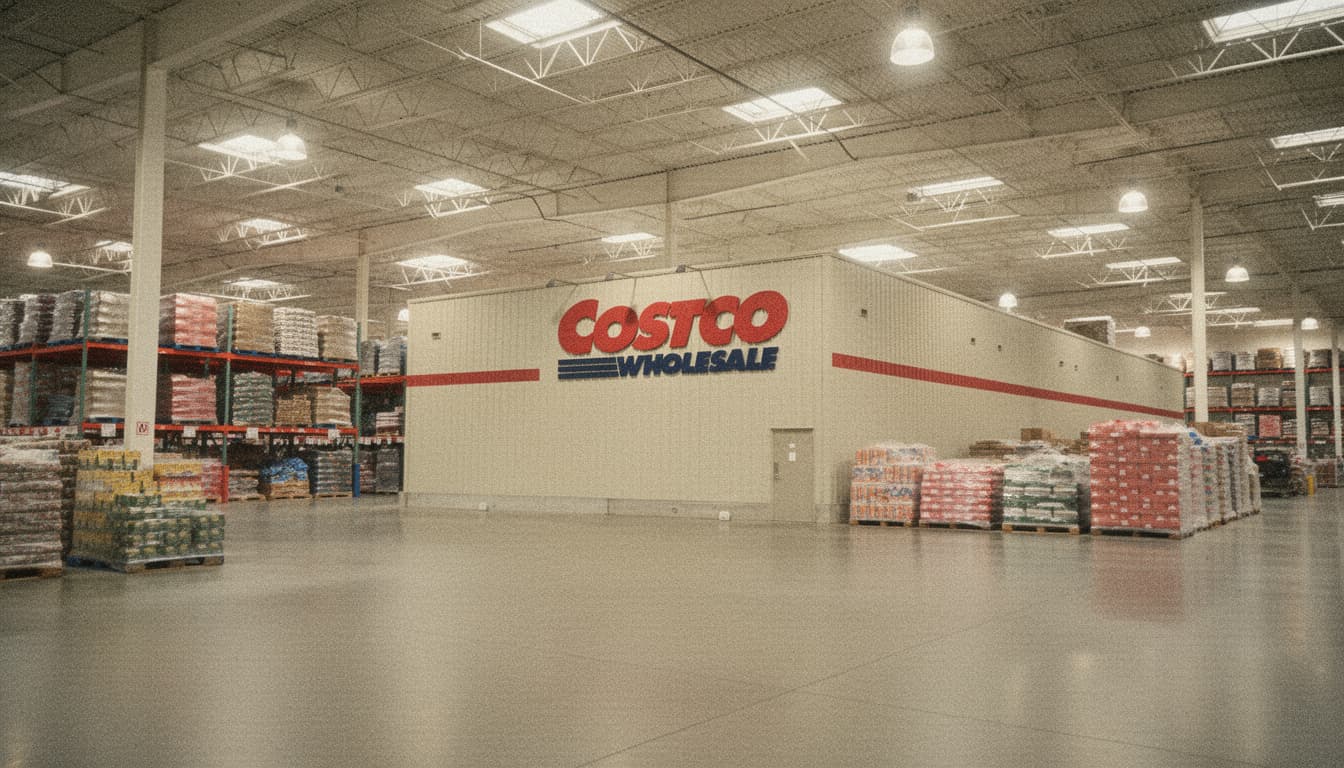
People often assume Costco competes on price. It does, but not the way you'd think. Costco doesn't undercut competitors through ruthless negotiations or automation that slashes costs. It undercuts them by eliminating the overhead that makes traditional retail so expensive. No displays. No marketing. No fancy storefronts. The building itself is a statement: we spend money on the product and the efficiency of delivery, not on seduction.
This becomes visible in Costco's cost structure. Labour as a percentage of sales is comparable to most retailers, but labour is used for receiving and restocking, not customer experience theatre. Utilities are high because the warehouses are massive, but that's offset by the density of transactions. You can't run a beautiful flagship store in Manhattan and sell tomatoes at $0.99 a pound. Costco can, because their aesthetic is efficiency.
The aesthetic of a warehouse is the aesthetic of honesty. No markup. No hidden costs.
The thin margins scare away competition. When Walmart tried to launch a membership warehouse model, it never took off with Costco's intensity. Costco's focus created an unreplicable culture. The company doesn't try to be all things to all people. It's ruthlessly curated. A typical Costco carries 4,000 items. A supermarket carries 30,000. That seems like a weakness. It's actually the blueprint.
The aesthetic of a warehouse is the aesthetic of honesty. No markup. No hidden costs.
The Culture That Compounds
Costco's founder Jim Sinegal built something unusual: a company that genuinely treats employees well, pays them above-market wages, and treats that investment as the foundation of the business, not a drag on it. Employee turnover at Costco is substantially lower than retail peers. That saves money on training and hiring. It also creates consistency. You go to your local Costco and you see familiar faces. That matters.
The culture has survived the retirement of its founders and the professionalisation of management. Current CEO Craig Jelinek extended the playbook. The $1.50 hot dog remains sacred. The membership model remains inviolate. New categories get tested, Costco Travel, Costco gas, Costco pharmacy, but always in service of the core thesis: reduce friction, increase value for members, build loyalty through economics, not marketing.
This is why Costco's stock has delivered such extraordinary returns over decades. Wall Street constantly expects the multiple to compress because margins are so thin. But Costco's membership base grows, renewal rates stay high, new members become dependent on the convenience and value, and the company becomes more embedded in the shopping routine.
The Endgame
Costco now operates across the globe, in markets from Japan to the United Kingdom. The model translates because the insight is universal: people would rather pay a membership fee and shop without pretence than have brands and theatricality imposed upon them. The aesthetic of a warehouse is the aesthetic of honesty. No markup. No hidden costs.
The question facing Costco isn't whether it stays dominant, the evidence suggests it will. The question is whether any competitor will ever truly replicate what Costco built. Amazon tried with Prime. It's a different model, focused on speed rather than price. Walmart has the scale but not the cultural conviction. Target has the design but not the membership lock-in.
Costco's enduring genius is philosophical. It decided that profit was secondary to loyalty, that margins were secondary to volume, and that the customer's trust was the only real moat that mattered. Ninety years of capitalism have tried to prove that wrong. Meanwhile, Costco keeps selling hot dogs at 1983 prices and printing billions of dollars of profit from membership fees.
End of file
The next one drops Sunday at 7am.
One long-form story a week, plus the tools, frameworks and tactics I’m using to run my own media business. Written from the operator’s seat — not the consultant’s.
No threads. No spam. Reply anytime — I read every one.