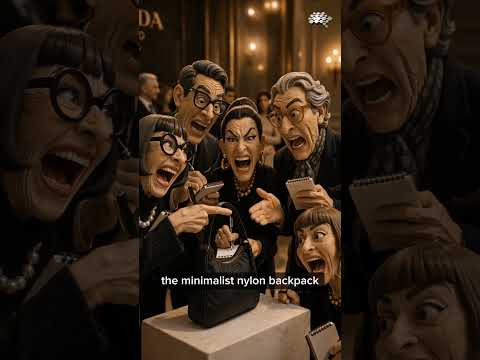
How Miuccia Prada Rewrote the Rules of Luxury by Making Ugly Beautiful
In 1978, Miuccia Prada inherited a failing leather goods shop and transformed it into an $8 billion empire by challenging every assumption about luxury. Her secret weapon: convincing the world that military tent fabric could be more desirable than exotic leather.
The Unlikely Revolutionary Who Changed Fashion Forever
In 1978, fashion's most unlikely revolutionary inherited a problem. Miuccia Prada found herself in charge of her family's struggling leather goods shop in Milan—a company that was quiet, dated, and financially fragile. The woman now responsible for saving it had spent the previous decade studying political science, performing mime at a theatre in Milan, and campaigning as a member of the Italian Communist Party. She had never designed a commercial product in her life.
The fashion industry expected nothing from her. They were spectacularly wrong.
Military Fabric Meets Luxury Pricing
Miuccia's first revolutionary act came during a visit to a factory that made military tents and parachutes from Pocono—a tough, water-resistant nylon, the same industrial fabric used to cover steamer trunks. Where others saw utilitarian materials, she saw possibility. Her decision to transform this military-grade fabric into luxury handbags was nothing short of heretical.
In an industry built entirely on the prestige of leather, exotic skins, and precious hardware, Miuccia Prada showed up with a backpack made from military tent material and charged a luxury price for it. The fashion establishment thought she had lost her mind.
"When she started, everybody hated what she was doing except a few clever people, and she kept going anyway."
Against all predictions, the minimalist nylon backpack became a cult status symbol, carried by the fashion elite from New York to Tokyo. The reason for its success was precisely what made it controversial—it wasn't glamorous, and that was entirely the point.
The Birth of 'Ugly Chic'
The nylon bag was merely the opening move. What Miuccia was really building was a completely new philosophy about what luxury even meant. Through the late 1980s and into the 1990s, her runway collections began deliberately breaking every rule the industry had written for itself.
Clashing colours that shouldn't work together. Silhouettes that were deliberately awkward. Fabrics that felt institutional rather than aspirational. Journalists started calling it "ugly chic"—a term that described outfits that were blatantly unsexy on first look, but revealed on closer inspection a daring intellectual take on beauty and desire that nobody else in fashion was exploring.
Embracing the Power of Manufactured Taste
Rather than defend herself against the "ugly" label, Miuccia embraced it completely. Her genius lay in understanding a fundamental truth about luxury: taste is not fixed. It is manufactured, and whoever controls the conversation about what is beautiful holds more power than any amount of technical craftsmanship ever could.
She wasn't simply making clothes—she was rewriting the definition of desirability itself, and making the entire industry follow her there. This wasn't fashion; it was cultural manipulation on a grand scale.
The Numbers Behind the Revolution
The market validated her audacious vision. By 1997, Prada posted revenue of $674 million. Today, the brand is valued at over $8 billion, built almost entirely on the conviction of a woman who took military tent fabric, called it luxury, and somehow convinced the whole world to agree with her.
The Lasting Impact of Intellectual Fashion
Miuccia Prada's revolution extended far beyond handbags and hemlines. She demonstrated that luxury could be cerebral rather than merely aspirational, that fashion could challenge rather than simply flatter, and that the most powerful brands are built not on what people already want, but on teaching them to want something entirely new.
Her approach proved that in luxury markets, conviction trumps convention every time. While her competitors chased established notions of beauty and status, she created entirely new categories of desire.
The Ultimate Luxury: Redefining Beauty
The most remarkable aspect of Miuccia Prada's success isn't that she built an $8 billion brand—it's that she did so by convincing the world to find beauty in what it had previously considered ugly. She understood that true luxury lies not in conforming to existing standards of desirability, but in having the power to create new ones.
In an industry obsessed with heritage and tradition, Miuccia Prada proved that the greatest luxury of all is the ability to make others see the world through your eyes. She didn't just change fashion—she changed the very mechanism by which we decide what deserves to be desired.
Watch the documentary
How Miuccia Prada Rewrote the Rules of Luxury by Making Ugly Beautiful
End of file
The next one drops Sunday at 7am.
One long-form story a week, plus the tools, frameworks and tactics I’m using to run my own media business. Written from the operator’s seat — not the consultant’s.
No threads. No spam. Reply anytime — I read every one.